

Critical Raw Materials Act: A new report criticizes sluggish progress in recycling, domestic mining, and processing, while also highlighting major transparency deficits.
The European Union’s heavy dependence on imports for critical raw materials has been known for years. In May 2024, the bloc launched the Critical Raw Materials Act (CRMA) to strengthen supply security. The regulation set out four key targets to be achieved by 2030.
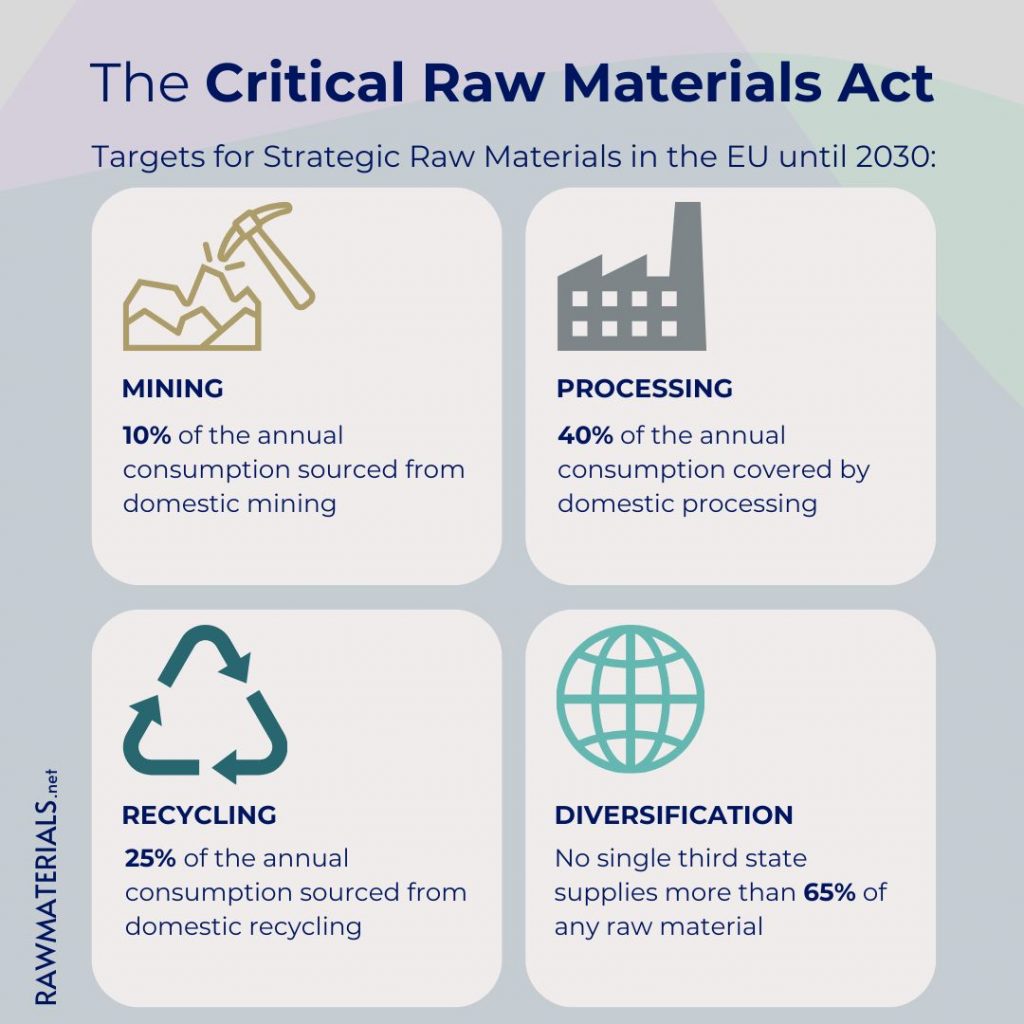
The EU’s targets under its Critical Raw Materials Act
However, implementation is at serious risk of failure. Progress has been too slow and insufficiently transparent, according to a recent report by the European Court of Auditors (ECA).
Efforts to diversify import sources have so far produced “no tangible results,” the auditors conclude. While the EU has signed 14 strategic raw-materials partnerships over the past five years, seven of these involve countries whose governments are considered “unreliable.” Between 2020 and 2024, imports from partner countries declined for around half of the raw materials examined. Compounding the problem is a lack of reliable data: in many cases, it remains unclear whether new partnerships or free-trade agreements have actually improved the availability of raw materials. The auditors also see significant shortcomings in recycling. For 7 of the 26 raw materials critical to the energy transition, current recycling rates are just 1–5 percent. For another ten, including lithium and gallium, no recycling is taking place at all.
Moreover, the CRMA’s recycling targets are described as overly vague. In particular, for hard-to-recycle materials such as rare earth elements, there are insufficient incentives to stimulate market development and industrial scale-up.
Domestic Mining Stagnates, Processing Capacity Shrinks
Progress in expanding domestic mining remains sluggish. Low exploration activity and long lead times for new mines are major bottlenecks, according to the ECA. Even more concerning is the situation in processing: domestic processing capacity is declining, with facilities being shut down, partly due to high energy costs. Whether these capacities can be reactivated in the future remains uncertain. The Court of Auditors also criticizes the financing framework. EU funding for critical raw materials initiatives is spread across numerous programs and instruments. Yet outcomes are neither systematically tracked nor evaluated. This assessment largely echoes long-standing criticism from industry representatives and trade associations, which have repeatedly called for revisions to the CRMA. Unless these weaknesses are addressed swiftly, the EU’s goal of securing a reliable supply of raw materials by 2030 will likely remain out of reach, the ECA warns. This would place the energy transition, industrial competitiveness, and the EU’s strategic autonomy under significant pressure.
The report follows similarly sobering assessments by the European Court of Auditors regarding EU targets for green hydrogen and strategic autonomy in the semiconductor sector.
Photo: Digital Visions via Canva