

Research at Trinity College Dublin shows how byproducts of the seafood industry could help recover critical raw materials while reducing industrial water pollution.
Each year, the global seafood industry generates millions of tons of waste, including shells from oysters and mussels. Much of this ends up in landfills or is stockpiled near coastlines. In many cases, these byproducts are already reused—for example as substrate for shellfish farming, as a source of lime, or through other forms of upcycling. Researchers at Trinity College Dublin have now explored whether this material could serve an additional purpose: recovering critical raw materials for industry.
A team of scientists found that seashells can absorb and store rare earth elements from water. These materials are essential for technologies such as wind turbines, electric vehicles, and consumer electronics. However, mining and processing them is complex, and traces of these metals can enter wastewater, contributing to environmental pollution. Seashells could therefore serve a dual purpose: helping to reduce water contamination while also repurposing an abundant waste material.
For the study, oyster, mussel, and cockle shells were collected from Irish beaches, cleaned, and finely ground. These particles were then introduced into a solution containing rare earth elements such as lanthanum, neodymium, and dysprosium at concentrations similar to those found in heavily contaminated industrial wastewater. The solution was heated to temperatures approaching 200°C.
Under the microscope, a clear chemical reaction became visible: the calcium carbonate in the shells began to dissolve and was gradually replaced by new minerals containing rare earth elements. These minerals crystallized directly on the surface of the shell particles. After several weeks, a thin layer formed, which the researchers describe as a kind of mineral “skin.”
Oysters Prove Especially Effective
One particularly striking result emerged with oyster shells. Due to their unique structure, they can absorb significantly more rare earth elements than the other shell types tested: one gram of oyster shell can bind up to about 1.5 grams of dissolved neodymium and related elements.
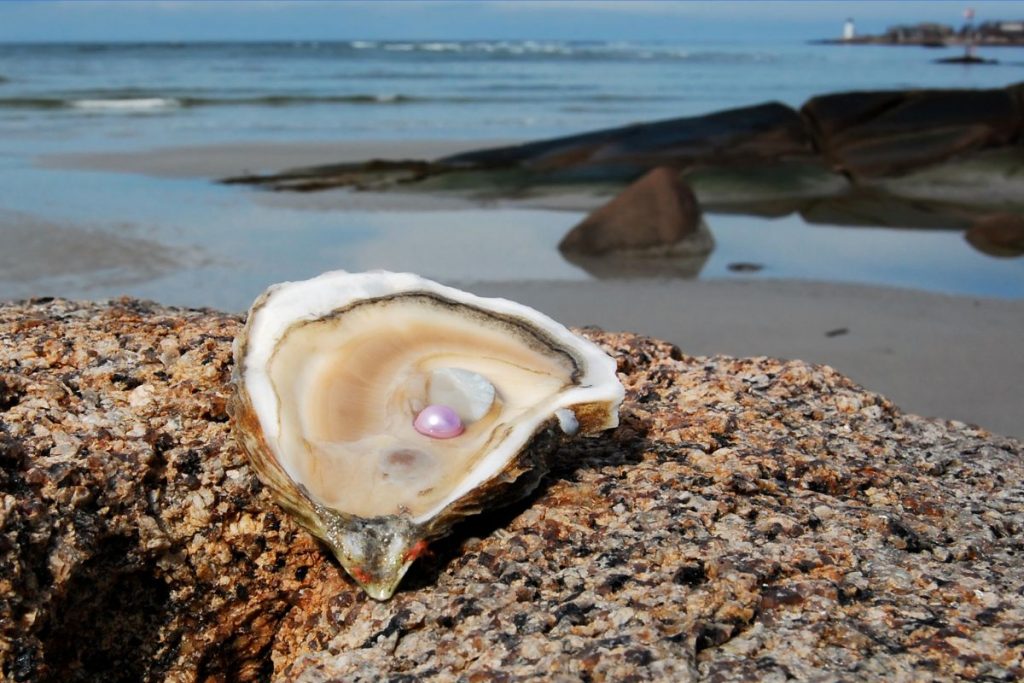
Oysters proved to be particularly effective at capturing rare earth elements. Photo: sbossert via Canva
According to the researchers, the resulting material could be further processed to recover the bound metals. Crushed seashells—especially oyster shells—could also be used in filtration systems or permeable barriers through which contaminated water flows. Such approaches are already widely used in water treatment, for example to remove heavy metals from seawater.
However, further research is needed before these findings can be scaled up for industrial use. Future studies must consider more realistic conditions, as industrial wastewater typically contains not only rare earth elements but also a wide range of other metals and chemical compounds. The researchers also aim to address practical questions, such as how much processing the shells require, including cleaning and grinding, and whether the approach can be implemented cost-effectively at scale.
More Innovation in Critical Materials: As demand for raw materials continues to rise and supply constraints intensify, new methods for sourcing critical materials are being developed worldwide. These include approaches using algae, bacteria, viruses, and molecular sponges. Seashells, too, have been the subject of previous research in this field.
Header photo: Truecreatives via Canva